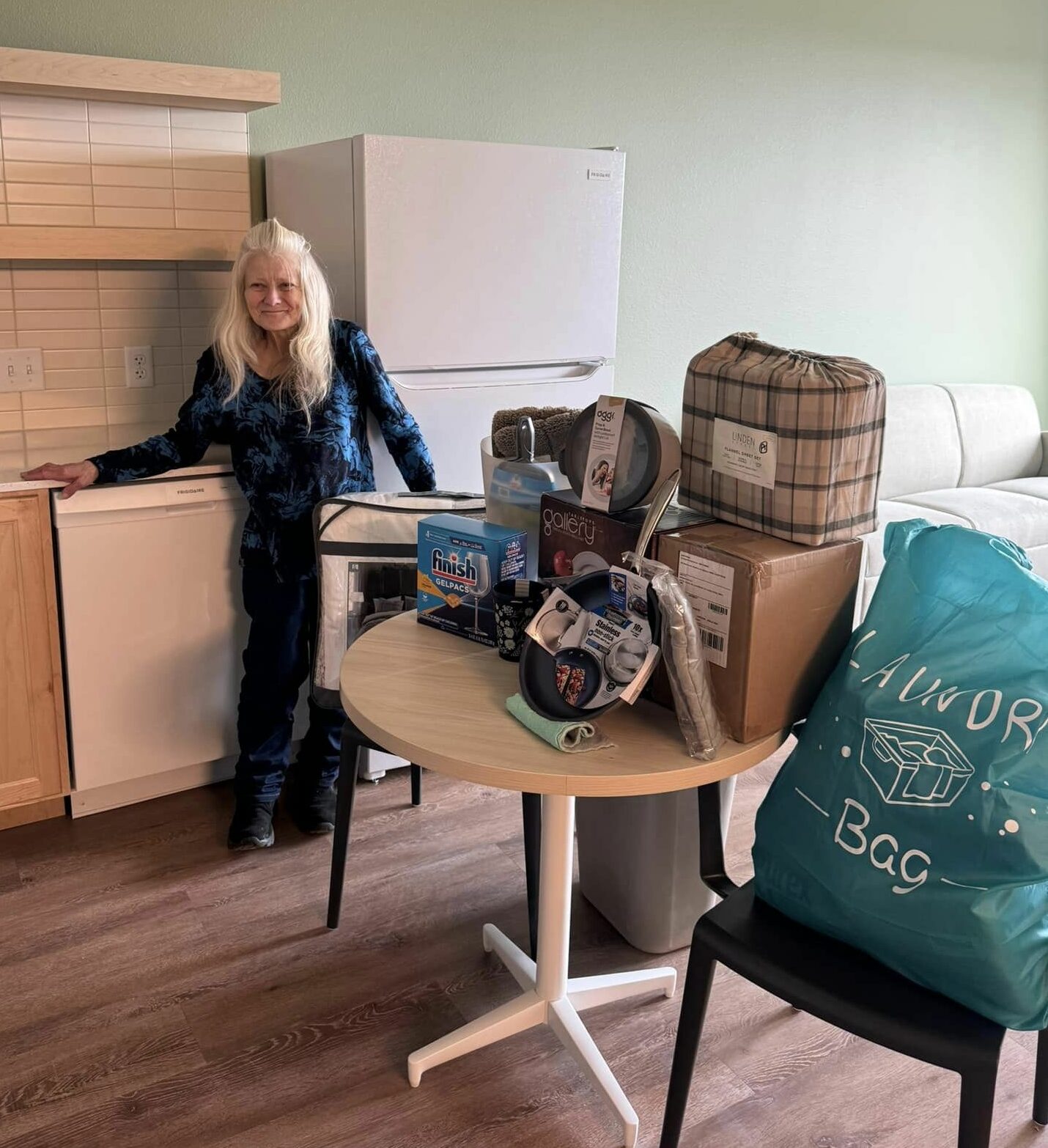
Moving into a new home can be an overwhelming experience, especially when you’re on a fixed income. For the residents of the St. Valentine supportive housing complex in Loveland, Colorado, those “little” things that add up were taken care of. Thanks to the tireless efforts of building coordinator Rob, all 54 units at St. Valentine’s received “starter kits” to help them get adjusted to their new living spaces. Parishioners at St. John the Evangelist in Loveland, and other individuals contributed thousands of dollars over the past few months to make sure every resident had all they needed to make their new house a home. Everything from kitchen to bath to bedding was included in these packages to make their transition as smooth as possible.
During the move-ins that started this month, residents have been lifted from many of the stresses of rising costs, with a warm place to call home this winter season. Paired with these “starter kits,” 80 individuals are that much closer to having all of their basics met. These tokens of kindness are what the Loveland community is all about.
On top of the $400 worth of items that were purchased for each unit, Rob also arranged for $50 Safeway gift card to be given out. These gift cards gave residents a chance to stock their pantries and fridges up for the first couple of weeks.
For the 80-plus individuals receiving income-based housing at St. Valentine’s, this is the start of a wonderful new chapter in their lives. A place to call home, and items that make it feel even homier. Thank you to the city of Loveland for welcoming this building into your community, and for welcoming some new neighbors with open arms. God bless.
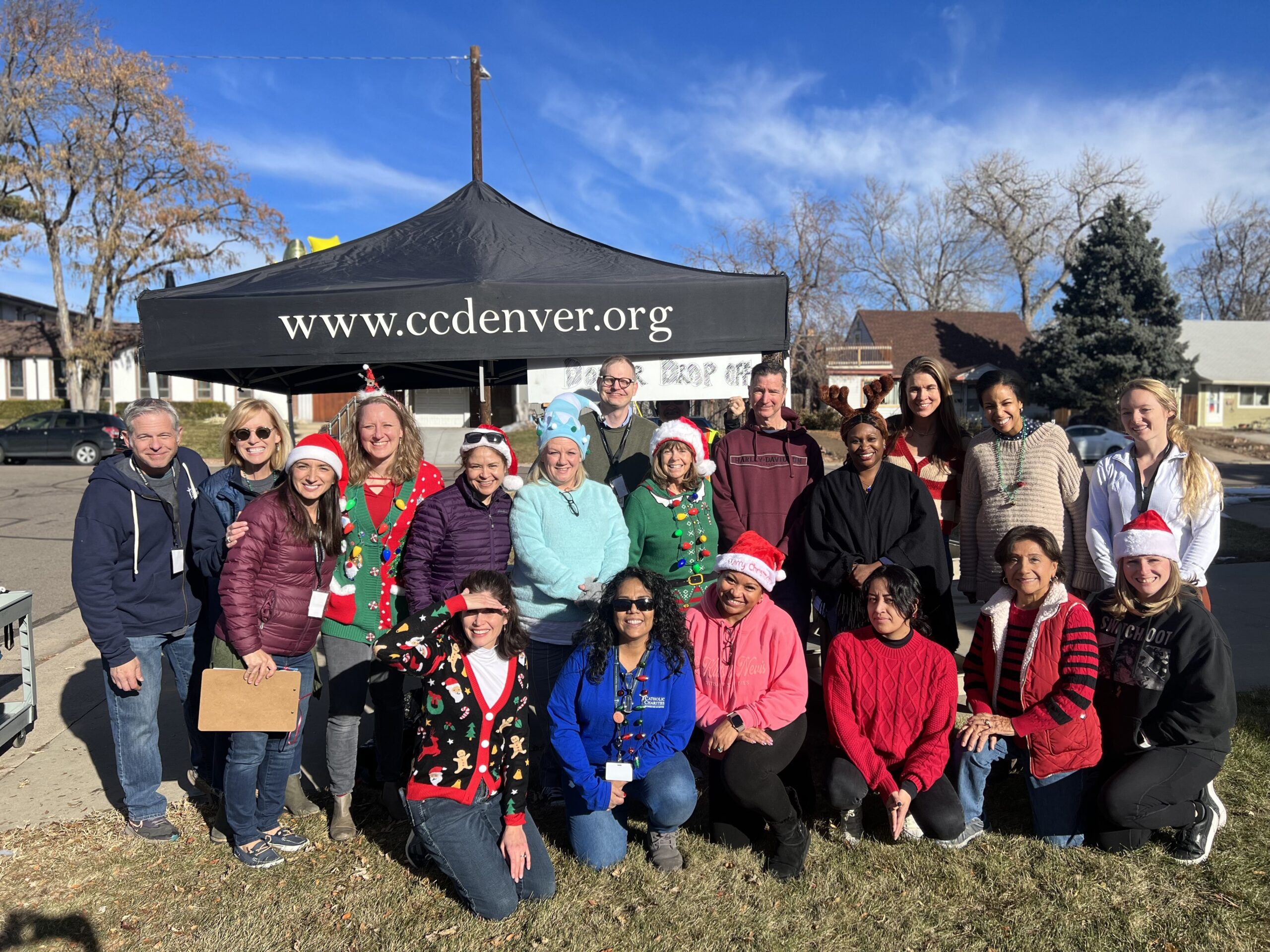
Over 4000 individuals will have gifts under their Christmas tree this year. The 25th anniversary of Adopt-A-Family was hugely successful, matching thousands of donors with families seeking assistance this holiday season. Thank you for your overwhelming generosity. The joy and relief you have provided these families is invaluable.
“It has become a tradition for us to get together as a friend group to find an organization to give to. We found this drive online and immediately knew these gifts were going to the right place and into the right communities. We were thrilled to get involved and will do it every year,” said Jason Schaffer.
Mother of two and Marisol Family participant Yesenia was getting off her 12-hour shift at Applebee’s when she picked up gifts for her family. With tears in her eyes and a tired smile, she shared her relief of not worrying about a joyful Christmas morning. For the past month, she’s picked up as many shifts as possible to make the basic ends meet. A Barbie doll for her daughter, new work shoes and a warm coat for her husband were on her list. They received so much more, thanks to the generosity of the Miller family in Wheat Ridge.
“I can’t wait for Christmas now.”
Growing up, Jana Lee and her aunt were actively involved in the Kinship ministry. She recalls receiving gifts from the Adopt-A-Family drive every Christmas. Years later, she is a college student in a human services program, striving to be a leader in the community. As a means of giving back, she went behind the scenes and volunteered to help with Adopt-A- Family.
“I wanted to find a way to give back.”
Pinar, a client at Marisol Health Denver, and her husband from Turkey are expecting a baby girl in the coming days. She received diapers, baby clothes and other necessities, as well as pampering gifts for Christmas this year to prepare for the greatest gift of all.
“We are so excited to have a new family member with us this Christmas.”
Lee and his grandson Beau have bonded over Adopt-A-Family, making it a tradition the whole family enjoys. They make a full day of shopping for families, with a lunch after to spend some extra time with one another.
The meaning behind Adopt-A-Family varies but the outcome remains was the same for all – to give and receive Christmas joy in a Christlike manner. We are so blessed by those in our community, ministries and other partners who 25 years of Adopt-A-Family, spreading the joy of the true meaning of Christmas. God Bless.
Eighth graders at Notre Dame Catholic School stepped up big this holiday season by extending the warmth of Jesus Christ to neighbors experiencing homelessness. When the school’s coat drive began last month, theology teacher Laura Gillette encouraged the students to connect with the Eucharistic Revival, a movement in the Catholic Church that is restoring the understanding of the living presence in the Eucharist.
After some brainstorming, they decided to collect coats for the shelters at Catholic Charities in Denver, to help them prepare for the cold weather approaching.
“When we talked about doing this as a class, we thought that it would be a unique way to participate in the Revival and deepen our connection with one another, and with the Eucharist. To know that we carry Jesus with us is a powerful thing. We have been teaching them about the Eucharistic Revival all year, so to find ways to apply that, is exciting for us.”
Keeping this notion in mind, the students rallied around their families to join them. The response received was overwhelming. Families and parishioners at Notre Dame worked together to fill an entire classroom with coats, warm clothing items and even non-perishable food items to live out the true presence of faith.
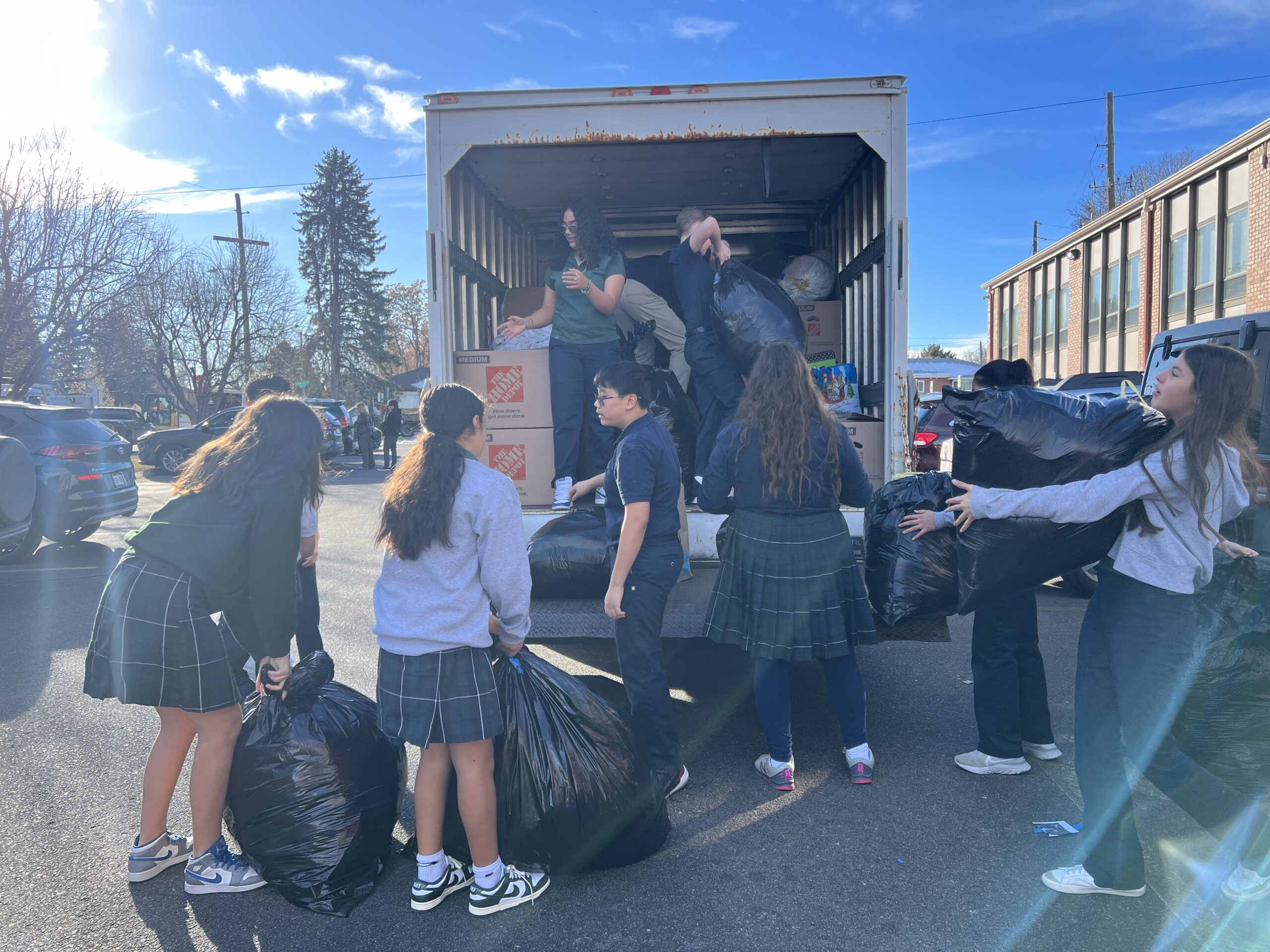
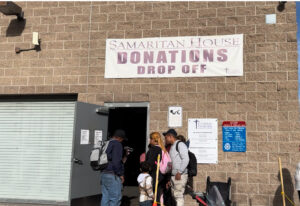
Once all the coats had been collected, the students worked together to sort and organize them, making sure that each coat found its way to the Samaritan House warehouse. They wrote notes of encouragement, letting the recipients know they were prayed for.
The class spent part of their school day loading up the Catholic Charities truck with boxes and watched as their hard work moved directly on to Samaritan House, to help their brothers and sisters in Christ.
Mark Hahn, director of volunteer and community engagement spoke to the class before he drove to the shelter’s warehouse. “If you can imagine, we have 100 to 150 people coming into our warehouse daily asking for help. This donation drive you put together will help people who come to us with a pair of sandals, shorts and a T-shirt on. This is what it’s all about.”
Loveland – the town, not the ski area – is known as the Sweetheart City with a long history of helping neighbors and welcoming strangers. The Catholic Church at the center of that tradition is St. John the Evangelist and parishioners there are turning the city’s reputation into reality for residents of Catholic Charities Housing’s newest affordable housing property.
St. Valentine’s Apartments will offer 48 one-bedroom and six two-bedroom units that could house up to 80 low-income tenants for a low monthly rent when it opens in end of this year. Each unit will come fully furnished, with access to site-wide internet services. Outside, tenants will have access to a large, landscaped courtyard with benches, tables and play equipment.
It is no secret that the housing market throughout Northern Colorado has skyrocketed, and housing costs have nearly doubled in Loveland over the past ten years. This jump in costs and interest rates has moved many longtime residents out of the region. With 30 affordable housing properties across Colorado, Catholic Charities Housing offers concrete solutions to the challenges of housing affordability and relies on partnerships to help residents create comfortable homes. With a firm understanding of the need for affordable housing in the community and a call to action after a Sunday Mass in May of this year, St. John the Evangelist in Loveland sprang into action to help.
For weeks, parishioners passed around a second offertory basket, collecting a $7,500 for the project. In addition to monetary donations, parish member Therese Hazzard volunteered her time to organize welcome packages for all the residents. These packages are no small feat, containing blankets, towels, housewares, gift cards and more, valued at around $500-600 each. To ensure everything was covered, Catholic Charities Housing ordered approximately $20,000 in Amazon items with the help of the parish donations to be delivered to Hazzard’s home so that residents have the essentials when they turn the key in their brand-new apartments when the building officially opens in late 2023.
“It’s heartwarming to see a community come together to support each other in such a meaningful way,” shared Justin Raddatz, Vice President of Development at Catholic Charities Housing. “As a parishioner of St. John the Evangelist, I am blown away by the generosity they have shown to keep our community housed. And to Therese Hazzard, we are humbled and blessed by your volunteer and monetary contributions.”
During speeches shared at the Grand Opening of Catholic Charities affordable housing property nearby, Immaculata Plaza II building in Greeley, affordable housing has been life changing.
Flora, a 72-year-old woman living in the brand-new building in Greeley said that, if not for the option for affordable housing in Northern Colorado, she would be living under a bridge. After her husband passed away, she was barely able to make ends meet for food. Now, she has a kitchen with brand new appliances, where she can walk to the store and make food for her neighbors.
The contributions of St. John the Evangelist in Loveland will directly help people like Flora in Loveland, to provide pots and pans for home-cooked meals, blankets for comfort and so much more. St. Valentine’s will serve as a protective space for dozens awaiting the day when they don’t have to worry about a place to call home.
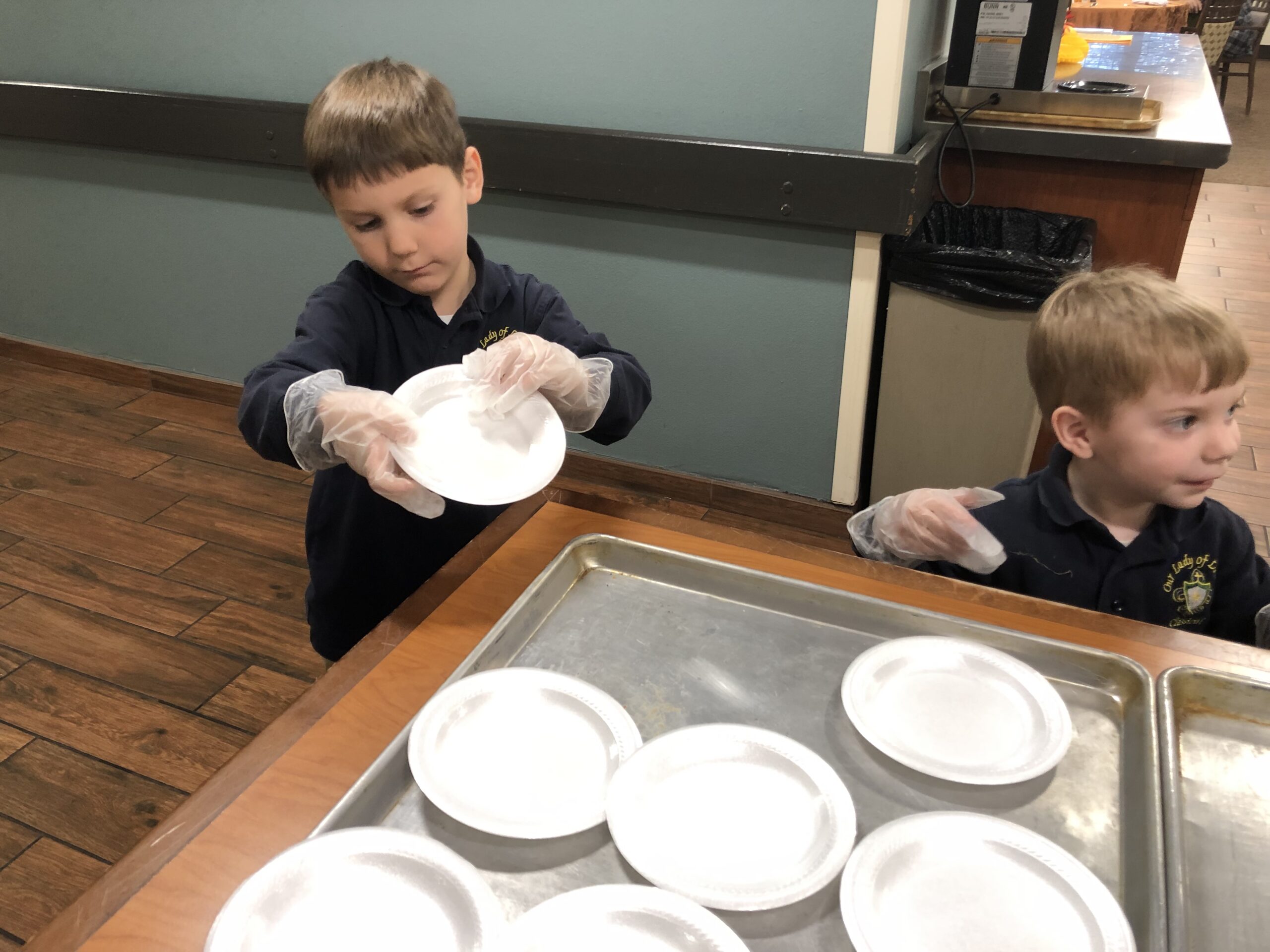
Henry and William Gosbeth, two young brothers from Our Lady of Lourdes Catholic School, recently spent their evening volunteering at Cathedral Plaza Apartments, a Catholic Charities Housing complex in Denver. Despite the fact they are only three and five years old, they were eager to help and spent time after school helping to prepare and serve meals to residents. Their time spent with the residents from a different generation is a reminder that connection is all around us if you take the time to find it.
Their father, Dan Gosbeth, who is the resident service coordinator at Cathedral Plaza, believes it is best to teach children how to give back to the community from a young age.
“It is crucial to instill in our children the importance of giving back as soon as possible.”
The boys were excited to jump in, and even though the kitchen gloves they wore were a few sizes too large, they worked hard to bring the food to the dozens excitedly waiting for their meal.
The residents of Cathedral Plaza were delighted to watch the two boys set up and prepare the meal, with one resident even guiding them in placing dessert plates on a tray prior to serving. The resident commended the boys for their great effort, and they were thrilled to receive such positive feedback. Other residents in the community room watched with smiles on their faces, proud of the young boys’ efforts, and seeing young people jump in to assist them. This experience was a great lesson for the brothers, teaching them that helping others and instilling a sense of pride and accomplishment can happen at any age.
Volunteering at Catholic Charities is a fun way to get your family involved in the community! Whether you are interested in assisting with a craft, event or meal, connections are ready to be made. Reach out to Jennifer Cerf jcerf@ccdenver.org or visit ccdenver.org/volunteer to browse volunteer activities.
“It’s the Most Wonderful Time of the Year,” is the timeless Christmas song by Andy Williams. It creates a beautiful picture of the perfect holiday season, where everyone is caroling and roasting marshmallows, where hearts are glowing. Everyone is telling you to be of good cheer! Doesn’t that sound lovely? This is the lyrical version of a Hallmark Christmas movie, where many people would prefer to spend their holidays, because reality is not nearly as idyllic.
The reality of the holiday season is that this time of year may involve singing marshmallows, and glowing hearts, and it can also bring feelings of sadness, loneliness, and stress. I have encountered many people who feel they are doing something wrong if they don’t feel “happy” during the holiday season. It’s easy to feel like you’re a Grinch in Whoville when you can’t embrace the fantasy that we’re all supposed to be cheerful and jolly for weeks. I’m here to tell you that it’s okay not to buy into the myth. Let’s look at the reality of the holiday season.
Why might we feel tired, sad, lonely, and stressed? First, the days get shorter, and we have less daylight, which means we feel tired earlier in the evening. With the cold weather and darker evenings, people who may exercise by walking, running, or riding their bikes may be less inclined to do so, mainly if snow and ice exist. Holiday parties often mean over-indulging on alcohol and foods high in sugar and fat, meaning that our bodies are more inclined to feel worse the next day. Then we add in the emotional challenges of this time of year. The holiday season causes many of us to think about loved ones who have died, and this naturally brings a tinge of sadness to the events where those people are no longer present. If this is the first few seasons after a loved one has died, you may even feel that you can’t celebrate at all, and that’s not uncommon.
When it comes to stress there are many reasons to feel stressed during this time of year. There are tremendous financial pressures in our hyper-consumer-focused society. Children and teens often wish for expensive toys and electronics and parents want to provide for those wishes. Many people choose to spend what they don’t have to see the look of joy on their kids’ faces. And then we come to the parties. The outfits, food, gifts and all the aspects of hosting and attending parties can be both fun and exhausting. Let’s face it, family get-togethers may bring more drama than delight at times. With different political, religious, and social views, family celebrations can create tension as quickly as contentment.
So, what are we to do? First, let’s accept that the idea of this being the most beautiful time of year is a myth. Maybe you’ll have weeks of unending bliss, but rather than feel let down when that doesn’t happen, let’s instead embrace the idea that we can create some beautiful moments during this time of year. How can we do that?
Get quality sleep. If you’re tired and you can go to sleep earlier, then do so! Intentionally turn off screens 2 hours before going to sleep to help your brain transition to sleep.
Exercise, exercise, exercise! If you can’t exercise outdoors, do something indoors. There are many exercise videos or suggestions online for people of all ages and abilities. There are so many benefits of regular exercise, but the one to focus on here is dopamine, which helps improve our mood.
Recognize that you may be missing a loved one who has died. Feel sad, angry, or lonely and express those feelings: cry, talk to a friend or therapist, journal, or write a letter to the person you miss. Then, focus on the loved ones around you and feel the joy and love you have by being fully present with them.
Focus on connection rather than perfection. Take the time to intentionally connect with people you care about this season. This may mean simplifying the party or holiday dinner so you can spend time eating, playing games, or watching movies with your family and friends.
Give to others. It really is better to give than receive! Volunteer at a shelter or foodbank or your church (see Catholic Charities’ website for lots of volunteer opportunities; insert link here). Or bake cookies and share with your co-workers or neighbors. Make sock and hand warmer bundles for the homeless person you pass to work. Find ways to brighten someone else’s day. When we get outside of ourselves, our brain feels rewarded and we can alleviate our feelings of loneliness and isolation, even if for a short while.
Accept your family members for who they are and take responsibility for your part in the drama. You know that your uncle will be prone to make some political remark to stir the pot and that you can quickly come back with a witty retort and then everyone is thinking, “Oh boy, here we go again!” Make an intention to refrain from engaging certain people on certain topics if you know it’s not going to get anywhere and will only lead to tension and conflict. Change the subject, agree to disagree, or excuse yourself to get some fresh air if needed.
Finally, and most importantly, let’s focus on our beautiful Catholic tradition. The season of Advent begins on December 3rd and is the time we spend preparing for the birth of Jesus Christ, the Light of the World. If we are preparing our hearts, then our focus will be on prayer and asking how we can fully receive the gift of Jesus into our lives. We can still participate in the parties, marshmallows, and caroling, but we can also slow down and remember that Jesus truly is the Reason for the Season. Take time to reflect and decide how you want to spend this holiday season; how can you put Jesus at the center of all you do?
Dr. Michelle Connor Harris
Executive Director, St. Raphael Counseling Female Hiker Walking Across the Forrest Field in Winter 640317540 Femininity, Serene People, Extreme Terrain, Physical Activity, Leisure Activity, Wellbeing, One Young Woman Only, Copy Space, Adults Only, Beauty In Nature, Remote, Sports Clothing, Relaxation Exercise, Winning, Body Conscious, Cheering, Running, Jogging, Exercising, Healthy Lifestyle, Caucasian Ethnicity, One Person, Achievement, Success, Conquering Adversity, Getting Away From It All, Aspirations, Independence, Freedom, Adventure, Exploration, Solitude, Sport, Travel Destinations, Vacations, Nature, Lifestyles, Rural Scene, Outdoors, Cheerful, Athlete, Hiking, Recreational Pursuit, Activity, Europe, Winter, Landscape, Cold Temperature
Denver, Colorado – November 13, 2023 – Catholic Charities of Denver proudly announces the appointment of Jeannine Duffield as the new Respect Life Denver Director. Jeannine’s journey has been defined by her unwavering Catholic faith and an impressive background in healthcare quality, data analytics and strategic planning. Her commitment to the values of Catholic Charities has been evident through her years of dedicated volunteer work at Samaritan House Denver, Marisol Health and Marisol Homes. Her appointment as Director of Respect Life Denver represents a significant milestone in her service to the pro-life community.
“Throughout my years of volunteering, I’ve had the privilege of witnessing the exceptional and inspirational culture that defines Catholic Charities. Joining this remarkable team is a true honor. I’m excited about the opportunity to apply my professional skills and expertise to serve and uplift the lives of our neighbors across Northern Colorado. As I embark on this journey, I am filled with excitement and a deep sense of gratitude.”
With a career spanning over two decades, Jeannine has established herself as a healthcare industry leader, consistently delivering outstanding results. For the past eight years, she moved through the ranks, ultimately serving as the Executive Director of Client Solutions for MDinteractive, ensuring healthcare providers delivered exceptional patient outcomes. Jeannine held positions at Brookdale Senior Living and Procter & Gamble’s Healthcare division and holds a Master of Public Health degree from UCLA and a Bachelor of Science in Biology from UC, San Diego. She is a devoted wife of over 23 years, a mother to three daughters and an active parishioner of St. Thomas More parish in Centennial.
Together with the entire Catholic Charities community outreach team, the Respect Life Denver office will focus on:
• Parish Engagement: The team’s goal is to support the amazing work Respect Life offices are accomplishing across the Archdiocese and share best practices and good ideas to improve the culture of life across our state. Jeannine will be working with Mark Hahn to bring Respect Life Representatives together with Parish Ambassadors to coordinate parish-based events, educational programs and spiritual activities supporting the profound respect for life.
• Community Partnerships: Collaborations with pro-life leaders, non-profit organizations, healthcare providers and community volunteers will be cultivated to collectively foster a culture of life within the broader Colorado community. A key focus in this area will be to support the work of the Colorado Catholic Conference as the bishops of Colorado serve to uphold the dignity of human life and the common good in public policy.
• Alliance within Catholic Charities Ministries: Catholic Charities is filled with ministries that support neighbors at every age and at every stage of life. Marisol Serivces, Samaritan House, St. Raphael Counseling, Catholic Charities Housing, Early Childhood Education, Emergency and Victim’s Assistance, food support and a host of additional ministries make up the comprehensive network of Catholic Charities that serves neighbors across the Archdiocese of Denver. Respect Life is an integral part of that network, and Jeannine will unite and highlight the existing principles of respect for life across every ministry within the organization.
One of the first efforts Jeannine will support will be the launch of Catholic Charities’ newest pregnancy resource center, Marisol Health Northern Colorado. Opening in Spring ‘24, the fully equipped medical center will help women along the northern Front Range make important decisions about their reproductive health in an open and accepting atmosphere.
Jeannine’s focus on connections, collaborations and leadership in the active pro-life space will ultimately benefit all people from conception to natural death and build on the work of her predecessor, Lynn Grandon.
“Lynn Grandon’s Respect Life Denver leadership has been profound for the past decade and her impact will live on for generations,” said Stacy Baum, Vice President of Marketing & Community Engagement for Catholic Charities. “Building on that life-changing work, we are eager to support Jeannine and the entire team as Respect Life Denver advances to a new and exciting chapter.”
Respect Life Denver champions Church teachings regarding the sanctity of all human life, and we seek to transform Colorado into a place where every human being is valued and protected from the moment of conception until natural death.
The block that houses Samaritan House in downtown Denver is always humming with activity. From morning until night, volunteers hustle upstairs to help the Catholic Charities team serve meals; generous donors swing by the warehouse to drop off donations and our experienced staff work directly with families, single women and veterans to find the resources they need to secure permanent work and housing.
The block is busier than ever these days with newly arrived migrants coming to Denver. Some stay only a few hours before they head to their final destination, while others start making plans to connect with family members who already call Colorado home. Some of the lucky ones have been able to find temporary shelter at Samaritan House, while others are still working with the City of Denver and other agencies to find a place to live. But, as they work out those details, Samaritan House, thanks to the generosity of the community, has found critical ways to help.
Lines form early seven days a week and are filled with families, women and men who deeply appreciate receiving sack lunches, clean clothes, coats, blankets and other necessities that our Samaritan House warehouse team passes out to them with a smile and word of comfort.
Much can be said – and has been said – about the situation happening at the southern border, and almost everyone has strong opinions about it. But at the heart of the political challenges are confused and scared people who are thousands of miles from home, are cold and hungry and welcome any bit of support they can find.
For many, that support comes in the form of our Samaritan House warehouse team, who are spending their days sorting donated material necessities, making sandwiches and filling brown bags that are handed out to every person who is hungry. Watching the recipients, many of whom are small children, sit down on the curb and scarf down the sack’s contents is both heart-warming and heart-breaking.
As we did when the migrants first began arriving in our state in earnest in November 2022, the entire Catholic Charities team has leaned into our mission to extend the healing ministry of Jesus Christ to the poor and those in need. Responding to the demand for additional family shelter last year, our team jumped into action, converting available space including conference rooms and offices into additional family rooms. Now, instead of housing 25 families at a time, Samaritan House is sheltering, feeding and supporting more than 35 families each night.
Most recently, when the summer surge started to hit Denver, our Catholic Charities food and warehouse teams jumped into action again and stepped up the creation of more sack lunches than ever before. In October alone, volunteers and employees made and distributed more than 3,000 sack lunches to people who knocked on the door. That is in addition to the more than 500,000 meals we cook each year for neighbors across the Samaritan House community and Catholic Charities early childhood education programs.
The food is always a combination of donated and purchased items, making robust healthy meals. On a sunny Monday early in November, families and groups of men and women stood in line, waiting for their turn in the warehouse to pick up warm weather items, including sweaters, coats and blankets to prepare for cold nights ahead. Each received one of the sack lunches that had been thoughtfully made by our kitchen team and volunteers and most sat down immediately on the curb to devour the hearty roast beef sandwiches, chips, applesauce and protein bars.
Every single person who received a meal thanked the team and expressed profound gratitude.
One of the amazing women who helps run the Samaritan House warehouse told the story of a young family who had been through the warehouse earlier in the day with their baby girl, who appeared less than two months old. They had timed out of the Denver migrant sheltering program and were uncertain about where they would spend the night. They had concerns about the baby’s health and our team worked diligently to find as many warm clothes and blankets as possible for the family. But, as she told the story, her eyes weld up with tears, knowing that the family’s future was uncertain and difficult.
Over the past few weeks, when a call for volunteers and additional donations went out from the Archdiocese of Denver and Catholic Charities, the Colorado community stepped up. The Knights of Columbus delivered coats, parishes organized non-perishable food drives and families and individuals cleaned their closets and made the trek into downtown Denver to drop off donated items. Those donations have proven lifesaving.
Once again, we are asking for your help. Colorado has been blessed with a warm fall, but, as the newly arrived are about to find out, Colorado winters are cold. If you can help with additional materials or financial donations, everyone involved in our Catholic Charities ministry would be incredibly grateful. If you have time and capacity, please join us at Samaritan House or any Catholic Charities ministry as a volunteer.
As Bishop Rodriguez said when he blessed a renovation of Samaritan House two years ago, “Every day, Jesus walks through the doors of Samaritan House.” Your time, treasure and talent are needed now more than ever, and you can make a big difference in the lives of those we serve.
***
Donations of material items are always needed and appreciated. If you have any of the following items and would like to donate them to Catholic Charities to use in our ministries, you may do so at Samaritan House, 2301 Lawrence St. in Denver, between 9 a.m. — 4 p.m. Monday through Friday, and from 9 a.m. — 1 p.m. on Saturday and Sunday. We are in need of new or gently used clothing for men, women and children; non-perishable food; new undergarments still in the packaging and personal hygiene items. To learn more about material or financial donations to Catholic Charities, please visit ccdenver.org.
Volunteers are the lifeblood of Catholic Charities and we couldn’t serve without them. Same-day opportunities are available. Click here to volunteer. Thank you!
According to national statistics, senior loneliness and social isolation increase the risk of negative health factors by 50%. For seniors at our Catholic Charities Housing properties, forming bonds with others around their homes is a blessing.
Flora, Barbara, Pandora and Amy are residents of Immaculata Plaza Apartments in downtown Greeley, Catholic Charities Housing’s newest property, and have forged an unbreakable bond since they signed their leases in September. Known throughout the community as the Coffee Crew, these friends are living proof that friendship and care know no age or boundaries.
Catholic Charities operates 30 affordable housing properties across Colorado and cares for seniors, veterans, families and individuals at risk of homelessness.
Each morning at 9 a.m., the Coffee Crew gathers in the communal kitchen or out on the white-fenced patio. They talk about their children and their grandchildren, swapping stories about their best times and their challenging times. Most have loved ones, including spouses, parents, good friends and even children, who have passed away over the years.
Flora lost her husband of over 40 years in 2019, leaving a gap in the companionship that she had enjoyed for so long. “If I didn’t have this building, I would be out living in the streets. Thank you for this place,” she shared with tears in her eyes.
The group leans on each other to talk about their grief and anxieties, knowing they aren’t alone.
Pandora, the group’s spirited ringleader, shares that if one of them isn’t downstairs in time for their coffee and conversation, they check up on her to make sure everything is alright. Pandora spoke at the Immaculata Plaza II Grand Opening on October 19, 2023. “We’ve all had interesting lives and pasts up to this point. We don’t deserve to be thrown away like we are trash. There is so much potential and goodness in these people.”
For Mielson and so many individuals, Samaritan House is a lifeline. Her story of courage and determination began in her home country of Venezuela, where violence became an everyday occurrence. Her journey to the United States was grueling, marked by unimaginable hardships and a desire for a better life. Mielson’s escape from the turmoil of … Read more